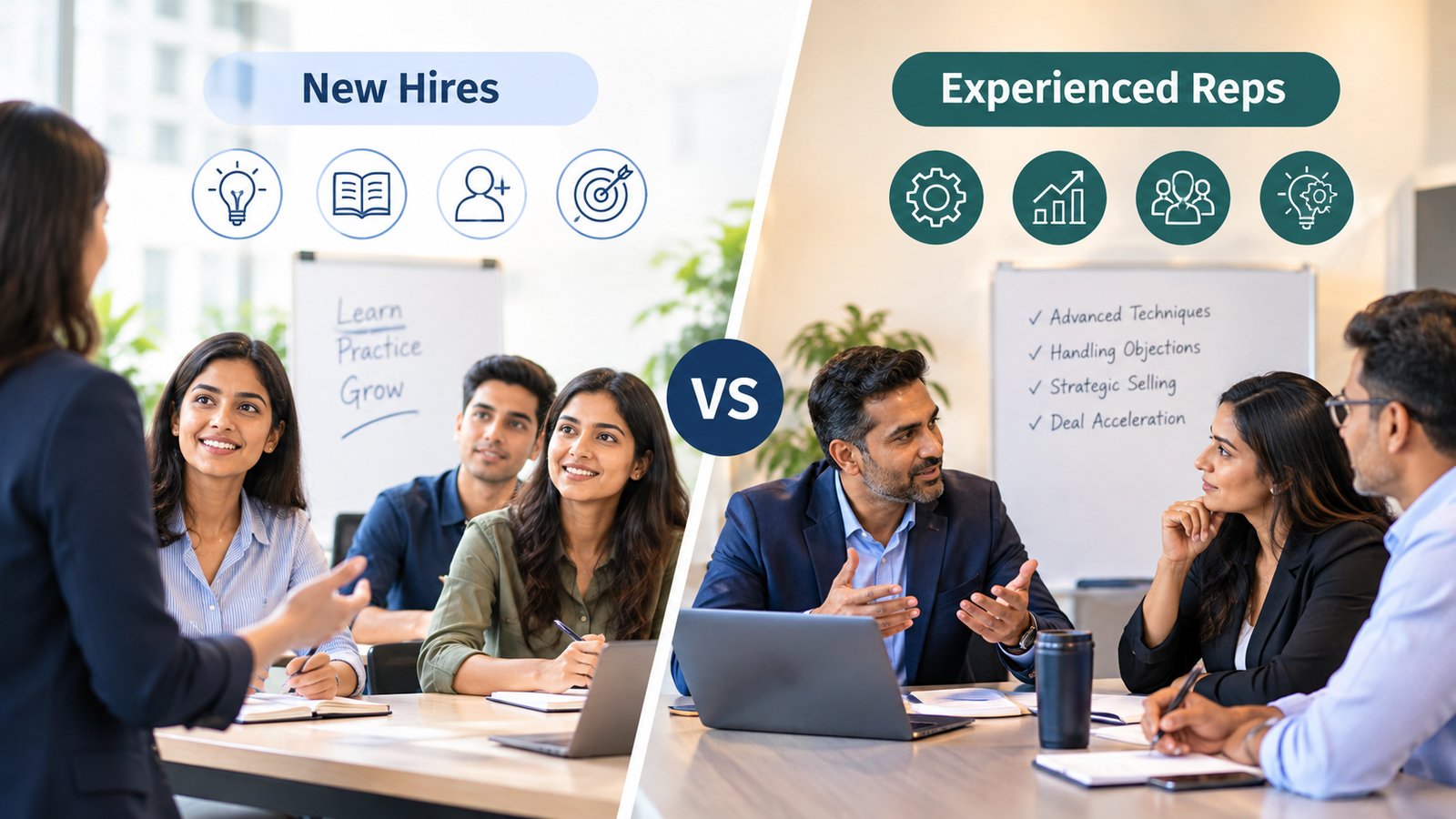
Every sales team is made up of people at different stages of their careers, and training them the same way rarely works. Effective sales training for new employees looks nothing like the programmes designed for experienced reps, and that’s by design, not by accident. Understanding these differences is the first step toward building a training strategy that actually moves the needle on performance, regardless of tenure.
Sales Training for New Hires vs. Experienced Reps: Quick Comparison
Here’s a quick side-by-side before we dig into the details:
| Training Focus | New Hires | Experienced Reps |
| Primary Goal | Build foundational knowledge and confidence | Sharpen skills and prevent stagnation |
| Core Content | Product knowledge, sales process, customer engagement basics | Advanced techniques, data utilisation, industry trends |
| Format | Structured workshops, role-play, simulations | Discussion-based sessions, peer learning, coaching |
| Common Challenge | Lack of real-world context and experience | Ingrained habits and resistance to change |
| Time to Productivity | Longer ramp-up, needs repetition and reinforcement | Faster ramp-up, but needs continual re-engagement |
| Best Learning Style | Hands-on practice in low-stakes environments | Peer-to-peer exchange and real-world case discussion |
With that overview in mind, let’s look at what each group actually needs, and why.
The Foundation: What New Hires Need
New hires are starting from zero. They don’t yet know your products, your sales process, or how your customers think, which means the first few weeks on the job set the tone for everything that follows. A structured corporate sales training programme for new employees should focus on three core areas:
- Product Knowledge: A comprehensive understanding of what they’re selling and, just as importantly, why it matters to the customer.
- Sales Process: Clear familiarity with your organisation’s sales cycle, tools and methodologies, so new reps aren’t improvising their way through early deals.
- Customer Engagement: Practical techniques for building rapport, asking the right questions and uncovering real customer needs.
The best sales training for new employees doesn’t stop at information-sharing but puts people in real-world scenarios early. Sales training workshops that include role-play, mock calls and simulations give new hires a low-stakes environment to practice, make mistakes and build confidence before they’re in front of an actual prospect. This hands-on approach consistently outperforms passive, lecture-style onboarding.
The Challenge: Re-Training Experienced Reps
Experienced reps present a different kind of challenge. They already know how to sell, but they also come with ingrained habits, some of which may no longer serve them as the market, product, or customer expectations evolve. Training at this stage isn’t about starting from scratch but about sharpening and updating what’s already there.
Effective sales training programmes for experienced reps typically focus on:
- Advanced Techniques: Introducing more sophisticated strategies and current sales trends to prevent skill stagnation.
- Data Utilisation: Teaching reps to actively use analytics, CRM insights and customer data to inform how they sell, rather than relying purely on instinct.
- Coaching and Feedback: Building a culture of ongoing improvement through structured feedback, mentorship and peer review.
Because experienced reps are often resistant to being ‘trained’ in the traditional sense, the format matters as much as the content. Discussion-based formats, peer-to-peer learning and exposure to real industry shifts tend to land better than repeating fundamentals they’ve already mastered. The goal is to keep them intellectually engaged, not just informed.
Finding the Balance
The most effective sales organisations don’t treat training as a single, one-time event. They treat it as a continuum. New hires need structure, patience and repetition. Experienced reps need challenge, autonomy and fresh input. Trying to force both groups through an identical programme tends to under-serve one side or the other, where new hires get overwhelmed or experienced reps disengage.
The better approach is designing tiered training tracks, a strong onboarding foundation for new employees, paired with ongoing, more advanced programming for tenured reps, so both groups are being developed in ways that actually match where they are.
The Role of Continuous Learning
Sales is not a static skill. Buyer behaviour shifts, products evolve, and competitors change tactics, which means training can’t be a one-and-done exercise for anyone on the team, regardless of experience level. Organisations that build a culture of continuous learning tend to see stronger long-term retention and performance. This can include:
- Reinforcement Training: Short, regular refresher sessions that keep core concepts top of mind without requiring a full retraining cycle.
- Guest Speakers and Industry Experts: Outside perspectives that introduce new ideas and prevent internal thinking from becoming stale.
- Collaborative Learning: Structured mentorship where experienced reps coach new hires, reinforcing their own skills while accelerating onboarding for others.
Conclusion
New hires and experienced reps are solving fundamentally different problems. One group is building a foundation, while the other is refining an existing one. Recognising this distinction, and designing sales training for new employees and tenured reps accordingly, is what separates sales organisations that grow consistently from those that plateau.
If you’re looking to build or refine a training strategy that works across every stage of your sales team’s development, let’s talk. Reach out to explore what a tailored approach could look like for your organisation.